

By: Benjamin Garden, Managing Director, Iris Pricing Solutions
You’ve probably seen the numbers. Industrial companies are leaving 3-5 margin points on the table, pricing teams are stuck in firefighting mode, and governance is consistently cited as the unlock. But knowing what’s possible isn’t the same as knowing how to get there. This article is about the how.
The Wednesday Morning You Recognize
In our experience leading pricing transformations across industrial markets, the successful ones come down to three core pillars: Governance, Metrics, and what we call an Insight Engine. Let me walk through each one.
Pillar 1: Governance (Designing the Decision Architecture)
Governance isn’t a policy document that sits in a drawer. It’s a decision architecture that determines who can approve what, under what conditions, and with what supporting data. The foundation is discount corridors by segment and order profile. Standard business that falls within the corridor requires zero pricing involvement. Sales reps can quote and close on their own. This alone transforms cycle time and frees up enormous capacity. Structured deviations (business that falls slightly outside the corridor) need one-up commercial approval. True exceptions go to a weekly deal desk with full margin waterfall visibility.
The immediate effect is that pricing stops touching 60-80% of all transactions. That capacity gets redeployed to strategy work instead of approvals.
Here’s what that transformation looks like in practice:
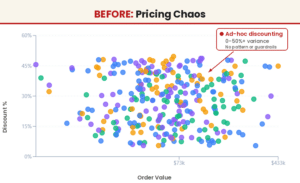
Each dot represents a single transaction, plotted by order value against the discount granted. In the first chart, you’re looking at pricing chaos. Discounts ranging from near-zero to 50%+ on transactions of similar size, scattered with no discernible pattern. This is what happens when every deal is negotiated ad hoc.
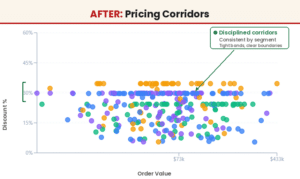
In the second chart, you’re seeing the same transaction landscape after corridor implementation. The dots compress into distinct horizontal bands, which are your pricing corridors. Each colored cluster represents a segment holding within its defined discount range. The wide vertical spray is gone, and what remains is disciplined, consistent pricing.
The business impact is immediate. Discount variance collapses, margin recovery follows. In the engagement shown here, the shift from scattered to banded pricing contributed directly to 3.2 margin points recovered. Beyond corridors, you need clear ownership lines. Pricing owns segmentation logic, discount guardrails, and channel price integrity. Product owns portfolio differentiation and value messaging. Sales owns execution within those guardrails (not approvals, execution).
We also recommend establishing a quarterly pricing council that’s small, cross-functional, and focused exclusively on structural decisions like segment margin targets, cost-to-price timing, and channel conflict resolution. No individual deal reviews. Quarterly cadence keeps it commercial without becoming bureaucratic.
Pillar 2: Metrics (The Diagnostics That Actually Lead)
Revenue and gross margin are lagging indicators. You need operational pricing diagnostics running in near real-time. The metrics that matter most include pocket margin by segment (what you actually keep after every off-invoice deduction), price waterfall analysis that exposes every leakage point from list to net to pocket, and discount distribution by rep and region. When sales reps can see where they fall relative to their peers on identical products, the “this customer needs a special deal” mythology tends to evaporate pretty quickly.
You also want to track cost pass-through velocity (the number of days between an input cost increase and customer price realization) and small-order economics, which is what it actually costs you to process and ship minimum orders. In most industrial businesses, small orders are destroying value and nobody’s measuring it.
Pillar 3: Insight Engine (Making Pricing Empirical)
Strategy in industrial markets has to be built on transactional reality, not intuition or anecdotes from the field.
Behavioral segmentation is the starting point. We’re not talking about SIC codes or firmographic data. We mean actual buying behavior like order frequency, basket composition, and observed price sensitivity. In nearly every engagement we’ve run, the stickiest, highest-service-cost customers are getting the deepest discounts. That’s a strategic choice someone made at some point, but usually nobody remembers why.
Win/loss price forensics compares quoted price versus realized price versus competitor benchmarks, broken out by product family. And controlled price testing means running targeted increases on low-sensitivity segments with tight volume tracking. You stop guessing where you have pricing power and start measuring it directly.
Inside the Transformation: A Real Case
Let me give you a real example. We worked with a specialty components manufacturer that recovered 3.2 margin points in nine months. The client had $420M in revenue, more than 14,000 active SKUs, 2,200 customer-specific price agreements, and a pricing team of four people spending most of their time processing exceptions. One product family alone had 47% price dispersion across customers buying identical volumes.
What we implemented:
We started with a price waterfall by segment. We mapped every single deduction from list price to pocket margin. The leakage wasn’t dramatic in any single place. It was death by a thousand cuts: inconsistent freight recovery, legacy rebates that nobody had revisited in years, small orders that cost more to fulfill than they earned, preemptive discounting because reps assumed customers would push back.
Next came corridor implementation. We designed discount corridors by customer segment and order profile and got them into production. The pricing team went from touching every deal to touching fewer than 25% of them. Then we did behavioral segmentation and targeted repricing. We mapped actual buying behavior against current pricing and discovered that the most price-sensitive customers were getting average discounts while the stickiest customers (who would never leave) were getting the deepest ones. Repricing was surgical, not across-the-board.
The results: Quote turnaround time dropped 40%. The pricing team flipped from 80% reactive work to 80% strategic work. And 3.2 margin points hit the P&L over nine months. No new products. No headcount increase. No expensive technology stack. Just structured commercial discipline applied to a business that had the data sitting there all along. Bringing Sales
Bringing Sales Along
Sales teams don’t resist price. They resist slow approvals, inconsistent rules, and surprises in front of customers. When the guardrails are clear and the system is fast, quote speed increases and price confidence rises.
Three moves that smooth the transition: First, involve your top-performing reps early in corridor design. They usually price well already and become natural advocates for the system. Second, reframe guardrails as speed for the sales team. The message is “close this deal in 20 minutes instead of waiting two days for approval.” Third, publish discount distributions across the team. Visibility kills outlier behavior faster than any mandate from above.
Your Move
If your pricing team is spending more time on approvals than on strategy, the margin upside is sitting there waiting for you. The logical next step is a conversation. We typically start with a 30-minute call where we walk through your current pricing structure, identify the two or three highest-impact opportunities, and give you an honest assessment of what’s achievable and how quickly you can get there.
Book a 30-minute pricing diagnostic call. Click below.