

What client conversations and market evidence suggest leaders should test before approving their 2027 pricing plans
Across recent client engagements and new-business conversations, we are hearing a consistent shift in the pricing discussion. Leaders are still considering price increases for 2027, but the more difficult questions now concern where an increase is defensible, how customers are likely to respond, and how much of the announced change may reach margin after discounts and other concessions.
The economic backdrop helps explain the change. U.S. consumer inflation reached 9.1 percent in June 2022 and was 3.4 percent in August 2026, after settling near 3 percent at selected mid-year points in 2023, 2024, and 2025 (U.S. Bureau of Labor Statistics, 2022-2026). These readings provide broad context rather than a proxy for any company’s input costs, which can follow a very different path. Even so, buyers who once accepted explanations rooted in economy-wide cost pressure are again asking whether price reflects the value they receive and whether credible alternatives are available.
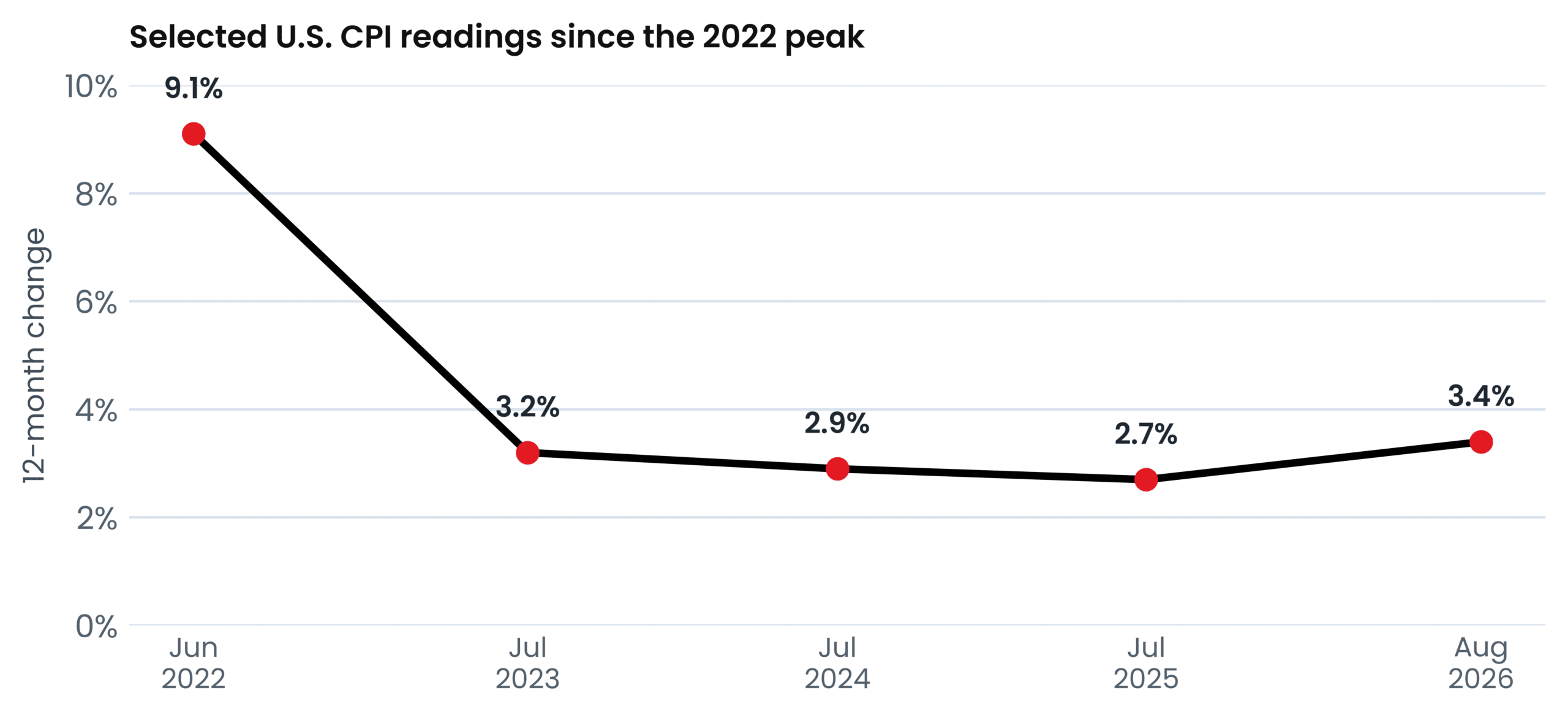
Figure 1. Selected annual snapshots provide broad economic context, not a sector-specific cost index. Points are connected for readability and do not represent the intervening monthly series. Source: U.S. Bureau of Labor Statistics.
That distinction was reinforced in recent conversations with more than a dozen senior pricing leaders across healthcare, manufacturing, chemicals, distribution, software, technology, business services, and private equity. They described uneven exposure to fuel, freight, commodities, tariffs, labor, and technology inputs. Their organizations were responding with emergency increases, indexed surcharges, monthly price updates, and targeted actions focused on economically material customers and products. Across sectors, pricing activity was becoming more continuous and more dependent on the organization’s ability to execute.
What we are hearing from clients and pricing leaders suggests that annual increases are becoming harder to separate from questions about differentiation, customer value, offer design, and execution. For 2027, a proposed increase is better treated as a hypothesis than a planning assumption: the plan should state where the business expects pricing power, what evidence supports it, what customer response is plausible, and who will measure the result.
Pricing Power Is a Specific Claim
Pricing power is not a general attribute that a company either has or lacks. It varies by customer, product, channel, relationship, and the availability of alternatives. In recent conversations, several leaders described narrowing rapid pricing actions to the countries, customers, and products that represented most of the financial exposure. This materiality-led approach can accelerate realization when updating an entire portfolio would delay action or overwhelm customers and commercial teams. It also requires a more specific understanding of which segments accepted the last increase, negotiated it away, reduced volume, or changed their mix.
External research supports the need for a more segmented view. A recent study of B2B markets found that price sensitivity can vary with customer size, reinforcing the limits of planning around a single average (Ghili and Yoon, 2026). The practical question is where the business is differentiated enough to support a change and where a higher price would expose weak value communication, competitive pressure, or a genuine risk to share.
The same issue is visible in consumer packaged goods. The Private Label Manufacturers Association reported that U.S. store-brand sales reached a record $282.8 billion in 2025, growing 3.3 percent compared with 1.2 percent for national brands (Private Label Manufacturers Association, 2026). That difference has several causes and does not prove that price alone drove switching. It does, however, validate a concern we hear in inquiries about promotion effectiveness and competitive intelligence: when differentiation is unclear, buyers have credible alternatives and a broad increase may not perform evenly.
The Evidence the Plan Is Missing
Recent inquiries often begin with a request for elasticity, competitive intelligence, promotion analytics, or an updated pricing model. Beneath those requests is usually a more basic need: a commercial view that connects customer, product, contract, rebate, cost, and volume data well enough to explain what the last pricing action delivered. For planning purposes, the relevant result is realized price and pocket margin after customer behavior and commercial concessions are taken into account, not the announced increase or the aggregate average alone.
Getting to that answer requires judgment. Customer hierarchies change, rebates may sit outside invoice data, and contract timing can distort comparisons. Price, volume, and mix effects are easy to confuse, and a customer buying less after an increase does not establish that price caused the decline. Even imperfect cohort-level analysis can show where an increase held, where it was negotiated down, and where the apparent result came from mix. The review should distinguish what the data shows from what the business can reasonably infer.
When a Pricing Problem Is Really an Offer Problem
One of the clearest themes in our association work is that the visible pricing question is often a portfolio question. Membership, events, education, certification, publications, and institutional products represent different purchasing decisions, yet they may be managed through separate teams with no shared logic for value, packaging, or discounting.
A recent professional association engagement illustrates the issue. More than 60 benefits were offered through essentially one membership package and price, although professionals, academics, students, and international members valued those benefits differently. Scenario testing indicated that a Good-Better-Best structure could improve retention and revenue performance by approximately 20 percent compared with the existing single-package model. The finding was a modeled opportunity, not a realized post-launch result, but it showed why the dues level alone could not address the underlying problem: members lacked options that reflected how they valued and used the organization.
Similar questions arise in other markets. A software provider may still price by seat when customers increasingly value usage or business outcomes, while an industrial supplier may focus on component price even when customers place greater value on uptime or service response. A higher rate may be justified in either case, but the decision should follow a clear view of the value delivered, the segments that recognize it, and the metric that best reflects it.
The Gap Between List and Pocket Price
Recent industrial, distribution, consumer, and private-equity inquiries also point to a second risk: the commercial plan may focus on list price while the business earns something materially different. Pocket price is what remains after discounts, rebates, freight allowances, payment-term concessions, promotional support, and other adjustments. When those elements have accumulated without systematic review, a five percent list-price increase can translate into a much smaller change in realized price.
The problem is often structural rather than a simple failure of sales discipline. Discount rules may have developed through years of individual exceptions, while incentives reward closing business without giving sales teams clear guidance on which concessions are economically justified. Trade spend, contract terms, freight, and rebates can create different forms of the same leakage.
A stronger plan therefore addresses the full price waterfall. It establishes visibility into realized price, defines discount and approval thresholds, and creates accountability for exceptions. It also gives finance and commercial leadership a regular view of whether the planned increase is reaching pocket margin and whether corrective action is needed before year end.
Pricing Requires Ownership
A pricing capability is more than an annual decision. Someone needs to own the analysis, the decision rules, the execution, and the reconciliation between the plan and the result. In many organizations, the commercial team owns the rate card and finance owns revenue reporting, while no one owns the gap between them. That arrangement can allow inconsistent discounting, delayed course correction, and repeated reliance on an average that the business cannot explain.
This issue becomes especially visible in private-equity diligence. Recent pre-close conversations have focused on customer-level realization, price dispersion, retention and volume after increases, contractual reset mechanics, discount leakage, and whether historical margin improvement depended on actions that may not be repeatable. A business that can explain how pricing decisions were designed, executed, and measured presents a different risk profile from one whose forecast rests on an unexplained historical average.
The same leaders repeatedly raised operational constraints, including fragmented price books, incomplete data, customer-notification requirements, billing limitations, and integration with ERP and quoting systems. The economics of an action may be sound while the organization remains unable to execute it quickly or consistently. A practical pricing capability begins with clear decision rights, a usable view of realized price, defined authority levels, and a review cadence that connects pricing outcomes to financial results while there is still time to act. Systems, incentives, and dedicated talent may become necessary as the capability matures, but they cannot substitute for ownership.
What a Credible 2027 Plan Contains
A 2027 plan may still include price increases, but it should compare them with other plausible actions. Depending on the segment and scenario, the right choice may be to hold price, share a cost increase, protect profit dollars, preserve margin rate, redesign the offer, or make a targeted increase where differentiation supports it. This scenario-based view is more useful than treating the highest feasible increase as the default.
Before approving the plan, senior leaders should be able to answer five questions:
- Where do we have evidence of pricing power, and where are we relying on assumption?
- Which customer and product segments are likely to respond differently?
- Does the offer and price metric reflect what customers actually value?
- How much of the change is expected to reach pocket margin after concessions?
- Who owns execution, monitoring, and corrective action during the year?
A plan built around those answers gives management a clearer connection between pricing, volume, retention, and margin. By the end of 2027, leaders should be able to show which pricing actions changed those outcomes and explain the likely drivers. That evidence is what turns the annual planning cycle into a repeatable pricing capability.
Iris Pricing Solutions works with commercial leaders and private equity-backed businesses on pricing strategy, revenue analytics, and go-to-market design. This article reflects observations from client engagements, recent conversations with more than a dozen senior pricing leaders, and publicly available market data. Practitioner observations are presented in aggregate and without individual or company attribution.
Sources
- U.S. Bureau of Labor Statistics. Consumer Price Index, June 2022.
- U.S. Bureau of Labor Statistics. Consumer Price Index, July 2023.
- U.S. Bureau of Labor Statistics. Consumer Price Index, July 2024.
- U.S. Bureau of Labor Statistics. Consumer Price Index, July 2025.
- U.S. Bureau of Labor Statistics. Consumer Price Index, August 2026.
- Ghili, Soheil, and Russ Yoon. An Empirical Analysis of Optimal Nonlinear Pricing in Business-to-Business Markets. Marketing Science, 2026.
- Private Label Manufacturers Association. 2026 Private Label Report, 2026.